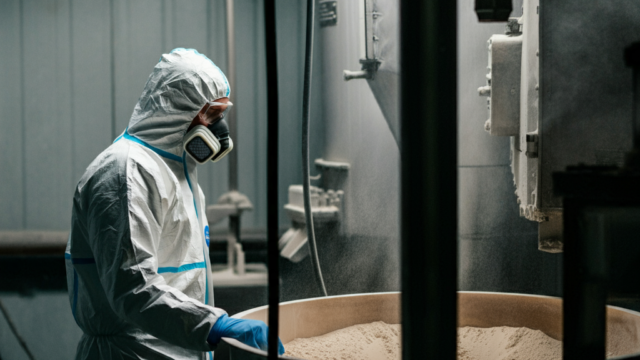
In powder handling environments, one of the most critical challenges is how to minimize dust generation.
Even a small amount of airborne powder can impact product quality—especially in food, battery materials, and chemical production—and increases cleaning work as well as operator burden.
This article explains the essential design points for creating a feeding system that keeps dust to a minimum.
1. Ensuring proper sealing is the top priority
Most dust leakage originates from tiny gaps in equipment.
Effective measures include:
- Gasket-sealed joints
- Clamp-type connections
- Improved sealing on lids and inlets
- Integrated hopper–feeder designs
When handling fine powders, even invisible micro-gaps can cause dust leaks.
Therefore, sealing performance must be treated as the highest priority.
2. Use negative pressure (dust collection) to capture airborne powder
Sealing alone cannot eliminate all dust.
Combining the system with negative pressure is highly effective.
Examples:
- Connecting the system to a dust collection duct
- Creating a negative-pressure zone near the filling port
- Local exhaust at the hopper top
Negative pressure is especially effective during material charging, line changeovers, and cleaning—moments when dust commonly becomes airborne.
3. Choose a feeding mechanism that naturally suppresses dust
The feeding method strongly affects how much powder becomes airborne.
A screw feeder is one of the most effective designs for dust reduction.
Advantages include:
- Powder is pushed forward, not blown out
- Stable, low-speed feeding reduces scattering
- Small openings minimize powder escape
- Easy integration with sealed covers
For many users, a screw feeder is the preferred choice when improving workplace cleanliness.
4. Optimize the design of inlets and outlets
Powder tends to disperse when there is a large drop height.
Useful improvements:
- Reducing the drop height at the discharge point
- Adding hoses or spouts
- Using enclosed shrouds around the inlet
- Installing smooth flow guides
Even small changes often produce a noticeable reduction in dust levels.
5. Use appropriate speed control based on powder characteristics
Fine, lightweight, or vibration-sensitive powders become airborne easily—especially when moved at high speed.
Key control strategies:
- Low-speed, stable feeding
- Soft start / soft stop
- Optimized pulse feeding
Screw feeders excel at these types of speed control, making them highly effective for minimizing dust.
About Seiwa Giken
Seiwa Giken provides Mini Screw Feeders and Standard Screw Feeders designed with dust control in mind.
We optimize sealing, negative-pressure integration, and rotational control based on each material’s behavior, and offer testing to determine the best feeding conditions—even for powders that easily generate dust.
👉 Learn more about Seiwa Giken’s Screw Feeders↓↓