Introduction
One of the most frustrating situations in powder handling is when a feeder performs perfectly during testing but fails after installation in the actual production process.
The feed rate was stable during the trial.
The powder flowed smoothly.
Everything appeared to work as expected.
However, once production began, problems started to appear:
- Feed rate fluctuations
- Powder bridging
- Unexpected blockages
- Material buildup
- Complete feeding stoppages
So, what changed?
In many cases, the feeder itself is not the problem.
The difference lies in the operating conditions.
Testing Conditions Are Often Different from Production
Laboratory or factory acceptance tests are usually performed under controlled conditions.
For example:
- Fresh powder
- Small batch sizes
- Short operating periods
- Stable temperature and humidity
- Operator supervision
Production environments are very different.
The feeder may be expected to run continuously for several hours while handling much larger quantities of powder under changing environmental conditions.
Even if the equipment remains unchanged, the powder may behave completely differently.
Long Operating Hours Can Reveal Hidden Problems
Some feeding issues only appear after continuous operation.
For example, cohesive powders may gradually adhere to internal components.
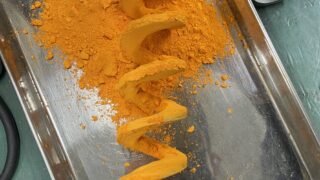
Over time, material can accumulate around the screw or inside narrow clearances.Initially, the feeder continues operating normally.
As the buildup increases, operators may notice:
- Reduced feed rate
- Higher motor load
- Inconsistent discharge
- Complete blockage
These problems may never appear during a short test run.
Powder Properties Can Change During Production
Another important factor is that powders rarely remain in exactly the same condition.
Material properties may change because of:
- Moisture absorption
- Temperature variations
- Bulk density changes
- Powder compaction during storage or transportation
Even when using the same material specification, different batches may not flow identically.
This is particularly important for low feed rate applications, where even small changes in powder behavior can significantly affect feeding accuracy.
Hopper Conditions Also Change
Testing is often performed with a partially filled hopper.During production, however, the hopper may be filled to a much higher level.
The increased weight of the powder changes the stress acting on the material.
Depending on the powder characteristics, this may increase the likelihood of:
- Bridging
- Ratholing
- Compaction
- Irregular powder flow
As a result, feeding performance under production conditions may differ significantly from the initial test.
Selecting the Right Solution
Because powder behavior varies from one application to another, there is no universal solution.
Instead, the feeder should be adapted to the specific material and process.
Depending on the application, possible improvements may include:
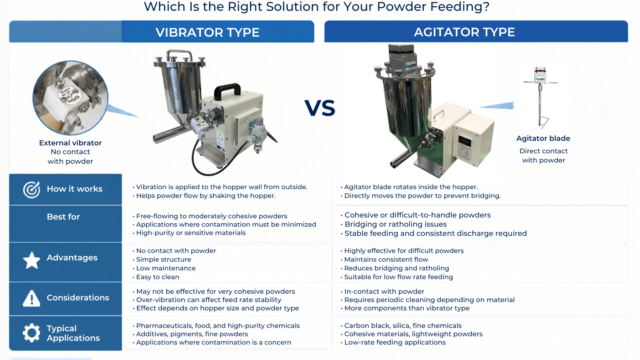
- An agitator for cohesive powders
- A vibrator to improve powder flow without contacting the material
- A shaftless screw for adhesive powders
- Air or nitrogen purging for moisture-sensitive materials
- Intermittent feeding for extremely low feed rates
Small design changes can often produce significant improvements in long-term feeding stability.
Consider the Entire Process
When evaluating a powder feeding system, it is important to look beyond the feeder itself.
Questions worth asking include:
- How long will the feeder operate continuously?
- Has the powder been stored for an extended period?
- Is the material sensitive to humidity?
- Does the hopper remain full during operation?
- Has the powder behavior changed since testing?
Answering these questions often helps identify the real cause of feeding problems.
Conclusion
A successful laboratory test does not always guarantee successful production.
As operating conditions change, powder behavior can also change.
Long operating hours, humidity, hopper loading, and material characteristics may all influence feeding performance.
Rather than assuming the feeder has failed, it is often more effective to evaluate how the powder behaves under actual production conditions.
Understanding the application as a whole is the first step toward achieving stable and reliable powder feeding.
Related Articles
- Why Does a Powder Feeder Stop Feeding Even When the Motor Is Running?
https://seiwag-us.com/blog/motor/
Why Ultra-Low Powder Feed Rates Are More Difficult Than You Think?
https://seiwag-us.com/blog/low-feed-rates/ - Vibrator vs. Agitator: Which Solution Is Better for Preventing Bridging?
https://seiwag-us.com/blog/v-a/ - Why Are Compact Feeders with Air Purging and KF Flanges Increasingly Requested?
https://seiwag-us.com/blog/air-purge/