Introduction
Bridging is one of the most common challenges in powder feeding applications.
When powder forms a stable arch above the feeder inlet, material flow stops and the feeding process becomes unstable. To solve this problem, two common approaches are often considered:
- Vibrators
- Agitators
Both methods can be effective, but they work in different ways and are suitable for different applications.
This article explains the advantages and limitations of each solution and how to select the most appropriate option for your powder handling process.
What Causes Bridging?
Bridging occurs when powder particles interlock or adhere to each other, creating a stable structure inside the hopper.
Common causes include:
- Fine particle size
- Poor flowability
- Moisture absorption
- Powder compaction
- Cohesive material characteristics
Once bridging occurs, the feeder may experience inconsistent feeding or complete flow stoppage.
When a Vibrator Works Well
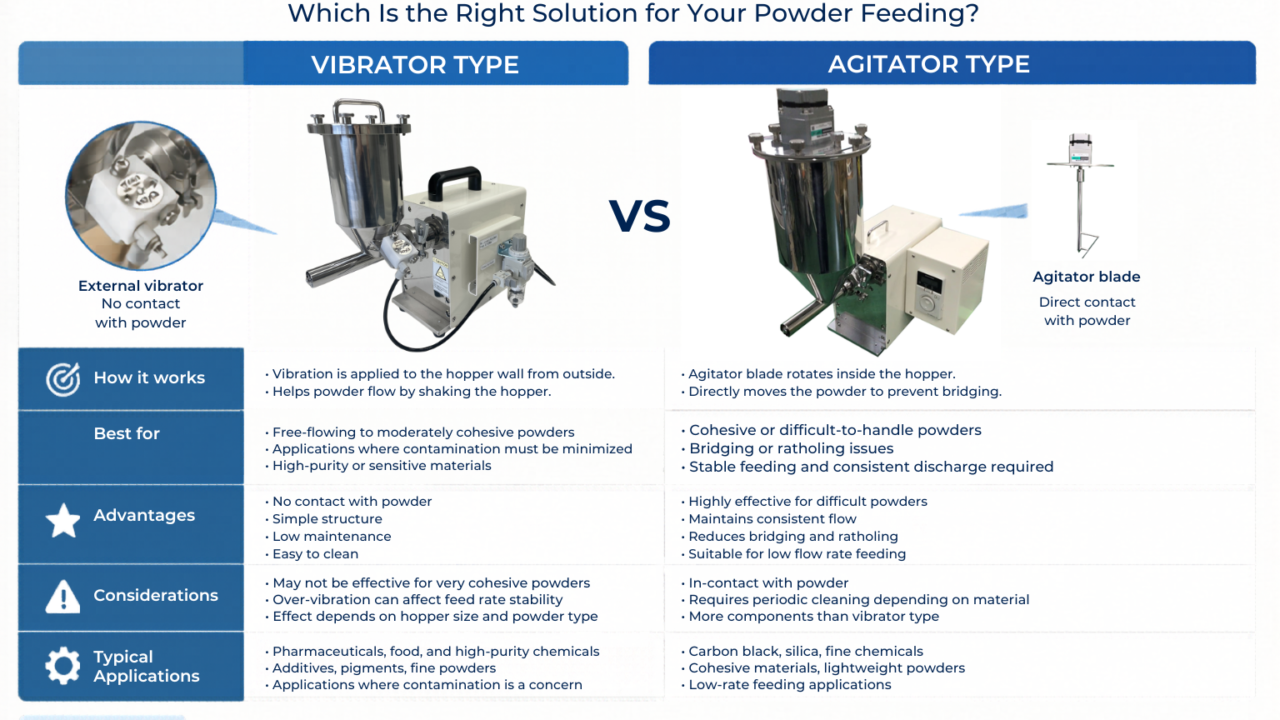
A vibrator applies external vibration to the hopper wall, helping the powder break free and continue flowing.
Advantages of vibrators include:
- Simple installation
- Low maintenance
- No contact with the product
- No additional components inside the hopper
Because the vibrator remains outside the product contact area, it is often preferred in applications where contamination must be minimized.
Typical examples include:
- Pharmaceutical materials
- High-purity chemicals
- Specialty powders
- Processes with strict contamination requirements
For free-flowing or moderately difficult powders, a vibrator may provide an effective and economical solution.
When a Vibrator May Not Be Enough
Although vibrators work well in many situations, they are not always effective for highly cohesive powders.
Examples include:
- Carbon black
- Fine silica powders
- Lightweight powders
- Certain additives and pigments
In these applications, vibration may not sufficiently break the internal powder structure.
For small hoppers used in low-rate feeding applications, excessive vibration can sometimes affect powder packing conditions and contribute to feed rate fluctuations.
How an Agitator Helps
An agitator works differently from a vibrator.
Instead of applying vibration from outside the hopper, the agitator directly moves the powder inside the hopper, helping maintain material flow around the feeder inlet.
Advantages of agitators include:
- Effective for cohesive powders
- Improved discharge consistency
- Reduced risk of bridging and ratholing
- Suitable for difficult-to-handle materials
Agitators are often selected when maintaining stable powder flow is more important than minimizing internal contact with the material.
Choosing Between a Vibrator and an Agitator
The best solution depends on the material and process requirements.
A vibrator may be preferred when:
- Contamination concerns are critical
- Powder flowability is relatively good
- A simple solution is desired
An agitator may be preferred when:
- Bridging occurs frequently
- Powder flowability is poor
- Stable feeding is essential
- The material is highly cohesive
In some applications, testing both approaches may be necessary to determine the most effective solution.
Product page for each solutions:https://seiwag-us.com/screw-feeder/mini-screw-feeder/
Conclusion
There is no universal solution for powder bridging problems.
While vibrators offer a simple, non-contact method for improving powder flow, agitators can provide more reliable performance when handling difficult powders.
Selecting the right solution requires consideration of powder characteristics, contamination requirements, and feeding stability.
Understanding these factors can help improve feeder performance and reduce production interruptions caused by bridging.